
The Acts of the Apostles – Acts 18:18-23 མཛད་པ། 18:18-23

(མཛད་པ། 18:18-23)

Acts 18.18-23 w B


After this, Paul stayed many days longer and then took leave of the brothers and set sail for Syria, and with him Priscilla and Aquila. At Cenchreae he had cut his hair, for he was under a vow. And they came to Ephesus, and he left them there, but he himself went into the synagogue and reasoned with the Jews. When they asked him to stay for a longer period, he declined. But on taking leave of them he said, “I will return to you if God wills,” and he set sail from Ephesus.

When he had landed at Caesarea, he went up and greeted the church, and then went down to Antioch. After spending some time there, he departed and went from one place to the next through the region of Galatia and Phrygia, strengthening all the disciples. (Acts 18:18-23)


Having performed a vow, perhaps of thanks to God, Paul went back by stages to his home church at Antioch in Syria. The first stage by sea took him to Ephesus, the main city of the province of Asia.

Because of his plan Paul did not accept the Ephesian Jews’ invitation, but he left Aquila and Priscilla with them. He did return. (Read future posts about this)

After visiting the church in Jerusalem and reporting back in Antioch Paul’s second journey was now finished. Later he set off again on his third missionary journey by first of all revisiting the young churches in Galatia such as those at Iconium and Lystra. (See map)
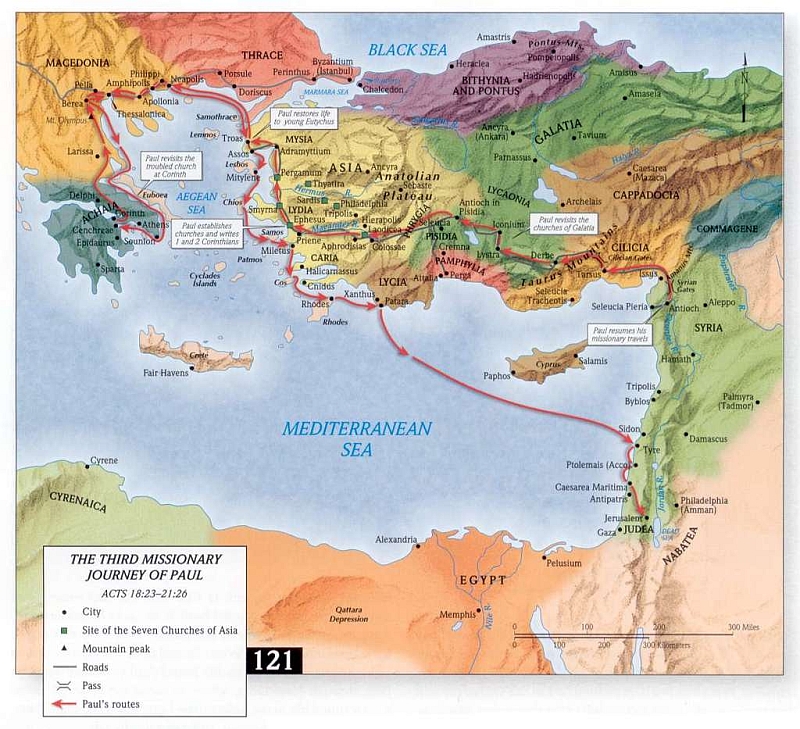

Paul 3rd Journey - 121 - 800px

The Acts of the Apostles – Acts 18:24-28 མཛད་པ། 18:24-28

(མཛད་པ། 18:24-28)

Acts 18.24-28 w B


Now a Jew named Apollos, a native of Alexandria, came to Ephesus. He was an eloquent man, competent in the Scriptures. He had been instructed in the way of the Lord. And being fervent in spirit, he spoke and taught accurately the things concerning Jesus, though he knew only the baptism of John. He began to speak boldly in the synagogue, but when Priscilla and Aquila heard him, they took him aside and explained to him the way of God more accurately. And when he wished to cross to Achaia, the brothers encouraged him and wrote to the disciples to welcome him. When he arrived, he greatly helped those who through grace had believed, for he powerfully refuted the Jews in public, showing by the Scriptures that the Christ was Jesus. (Acts 18:24-28)


In these verses we learn how Priscilla and Aquila continued Paul’s work at Ephesus; and in particular how God used them to instruct in some points the new believer Apollos, a man with such clear understanding of the scriptures, and with the courage and desire to show that Jesus was the Christ.

Apollos then traveled on to Corinth, where also the work begun by Paul was continued very effectively by him.

God provided leaders for the new churches in these two cities.

The Acts of the Apostles – Acts 19:1-10 མཛད་པ། 19:1-10

(མཛད་པ། 19:1-10)

Acts 19.1-10 w B


And it happened that while Apollos was at Corinth, Paul passed through the inland country and came to Ephesus. There he found some disciples. And he said to them, “Did you receive the Holy Spirit when you believed?” And they said, “No, we have not even heard that there is a Holy Spirit.” And he said, “Into what then were you baptized?” They said, “Into John’s baptism.” And Paul said, “John baptized with the baptism of repentance, telling the people to believe in the one who was to come after him, that is, Jesus.” On hearing this, they were baptized in the name of the Lord Jesus. And when Paul had laid his hands on them, the Holy Spirit came on them, and they began speaking in tongues and prophesying. There were about twelve men in all.

And he entered the synagogue and for three months spoke boldly, reasoning and persuading them about the kingdom of God. But when some became stubborn and continued in unbelief, speaking evil of the Way before the congregation, he withdrew from them and took the disciples with him, reasoning daily in the hall of Tyrannus. This continued for two years, so that all the residents of Asia heard the word of the Lord, both Jews and Greeks. (Acts 19:1-10)


When Paul did return to Ephesus he met a group who seemed to be disciples, but he found out that they also, like Apollos, had not been taught the full gospel of the way of salvation. They had repented of sin as John the Baptist had urged, but did not know Jesus’ promise to enter them in the form of his Spirit.

So when they were baptized in the name of Jesus, they could follow ‘The Way’*, that is, having his Spirit inwardly to help them in their changed lives and in their worship and in their speaking.

* ‘People-of-the-The Way’ was a name given to ‘Christ- men’. At Antioch they were known as ‘Christians’ ( see Acts 11:26).