The Acts of the Apostles – Acts 10:34-48 མཛད་པ། 10:34-48

(མཛད་པ། 10:34-48)

acts-10-34-48-w-b


So Peter opened his mouth and said: “Truly I understand that God shows no partiality, but in every nation anyone who fears him and does what is right is acceptable to him. As for the word that he sent to Israel, preaching good news of peace through Jesus Christ (he is Lord of all), you yourselves know what happened throughout all Judea, beginning from Galilee after the baptism that John proclaimed: how God anointed Jesus of Nazareth with the Holy Spirit and with power. He went about doing good and healing all who were oppressed by the devil, for God was with him. And we are witnesses of all that he did both in the country of the Jews and in Jerusalem. They put him to death by hanging him on a tree, but God raised him on the third day and made him to appear, not to all the people but to us who had been chosen by God as witnesses, who ate and drank with him after he rose from the dead. And he commanded us to preach to the people and to testify that he is the one appointed by God to be judge of the living and the dead. To him all the prophets bear witness that everyone who believes in him receives forgiveness of sins through his name.”

While Peter was still saying these things, the Holy Spirit fell on all who heard the word. And the believers from among the circumcised who had come with Peter were amazed, because the gift of the Holy Spirit was poured out even on the Gentiles. For they were hearing them speaking in tongues and extolling God. Then Peter declared, “Can anyone withhold water for baptizing these people, who have received the Holy Spirit just as we have?” And he commanded them to be baptized in the name of Jesus Christ. Then they asked him to remain for some days. (Acts 10.34-48)


See the amazement of the Jewish believers. It was because non-Jews were receiving the Holy Spirit in the same manner as the disciples had done in the first place (as described in Chapter 2 verses 1-13).

It was a sure sign that clearance ( sel tshar ba ) from all bad past actions ( las ) was offered by God through Yeshu to people of every nationality.

The Acts of the Apostles – Acts 11:1-18 མཛད་པ། 11:1-18

(མཛད་པ། 11:1-18)

acts-11-1-8-w-b


Now the apostles and the brothers who were throughout Judea heard that the Gentiles also had received the word of God. So when Peter went up to Jerusalem, the circumcision party criticized him, saying, “You went to uncircumcised men and ate with them.” But Peter began and explained it to them in order: “I was in the city of Joppa praying, and in a trance I saw a vision, something like a great sheet descending, being let down from heaven by its four corners, and it came down to me. Looking at it closely, I observed animals and beasts of prey and reptiles and birds of the air. And I heard a voice saying to me, ‘Rise, Peter; kill and eat.’ But I said, ‘By no means, Lord; for nothing common or unclean has ever entered my mouth.’

(Acts 11:1-8)


The leaders and other members of the church in Jerusalem are critical of Peter for staying with non-Jews.

Today also people, even Christian people, may say to preachers, “How can you go into monasteries ( dgon pa ) ? They have their own religion; just leave them alone.”

However, this passage tells us that it is right for Christians to explain to anyone how the cross of Jesus Christ is the way to forgiveness, even to Buddhists who want to know. And that is because God wants them also to have unfading life.

The Acts of the Apostles – Acts 11:19-26 མཛད་པ། 11:19-26

(མཛད་པ། 11:19-26)

acts-11-19-26-w-b

israel-n-middle-east-003

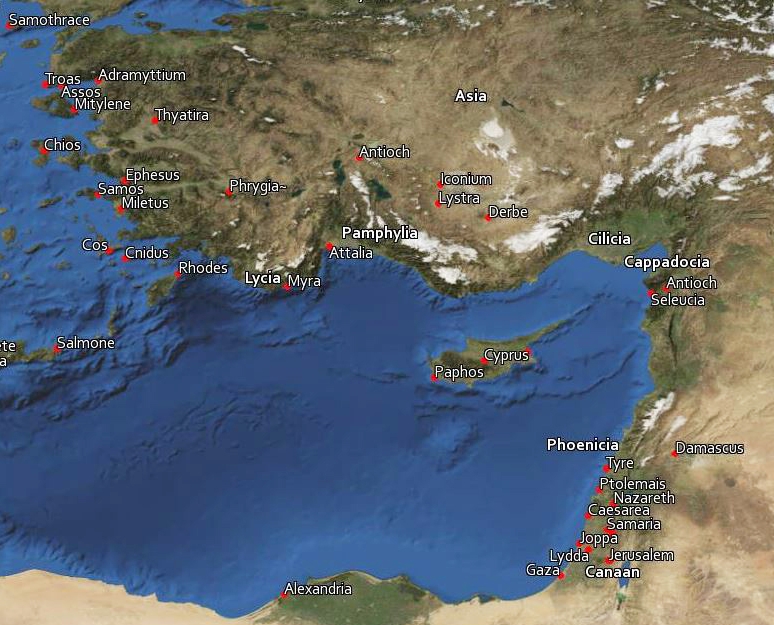
Now those who were scattered because of the persecution that arose over Stephen traveled as far as Phoenicia and Cyprus and Antioch, speaking the word to no one except Jews. But there were some of them, men of Cyprus and Cyrene, who on coming to Antioch spoke to the Hellenists also, preaching the Lord Jesus. And the hand of the Lord was with them, and a great number who believed turned to the Lord. The report of this came to the ears of the church in Jerusalem, and they sent Barnabas to Antioch. When he came and saw the grace of God, he was glad, and he exhorted them all to remain faithful to the Lord with steadfast purpose, for he was a good man, full of the Holy Spirit and of faith. And a great many people were added to the Lord. So Barnabas went to Tarsus to look for Saul, and when he had found him, he brought him to Antioch. For a whole year they met with the church and taught a great many people. And in Antioch the disciples were first called Christians. (Acts 11:19-26)


Many people from a different cultural background in Antioch the capital of the province of Syria  were now coming to faith in Yeshu.

As a result, perhaps as a Greek nickname spreading around in the large city, believers were being called Christians ( khi r’i’ si tho pa ) , meaning Messiah-men (ma shi ga pa) .

They were people of the Way, those who had chosen the short way of salvation (thar pa’ lam ) through the Saviour Yeshu who had said, “I am the Way”. They were Yeshu-men ( ye shu pa ).