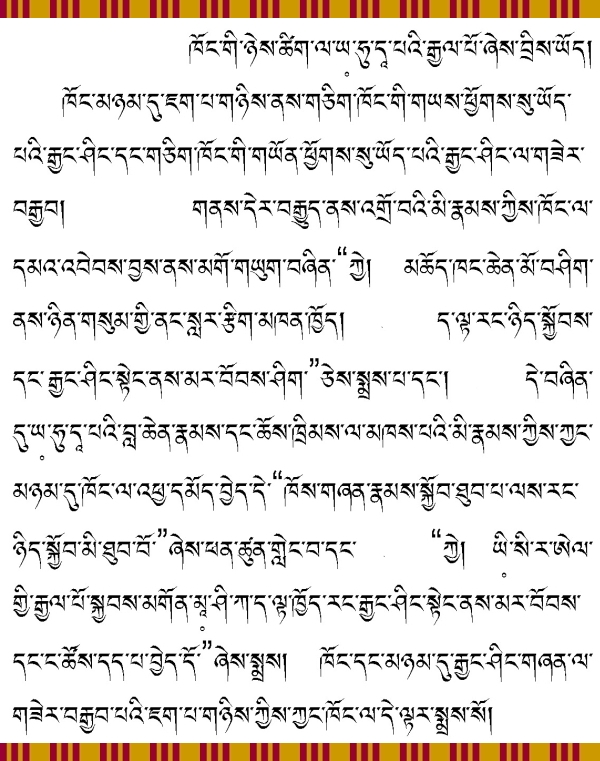
Tibetan Script Gospel Meditation – Mark 12:38-44

Mark 12.38-44 w B

And in his teaching he said, “Beware of the scribes, who like to walk around in long robes and like greetings in the market-places and have the best seats in the synagogues and the places of honour at feasts, who devour widows’ houses and for a pretence make long prayers. They will receive the greater condemnation.”

And he sat down opposite the treasury and watched the people putting money into the offering box. Many rich people put in large sums. And a poor widow came and put in two small copper coins, which make a penny. And he called his disciples to him and said to them, “Truly, I say to you, this poor widow has put in more than all those who are contributing to the offering box. For they all contributed out of their abundance, but she out of her poverty has put in everything she had, all she had to live on.”

Yeshu both warns of the pride of the scribes who pretend to be religious yet, like Chief Todong, love to receive honour from men; and he also warns of the scribes’ greed for presents because, like the Gomchen (sgom-chen) Ratna, they shamelessly steal from simple, helpless people. These people will be judged severely.

But it was the simple widow, quietly giving honour to God with her tiny but costly gift, whom Yeshu commended.

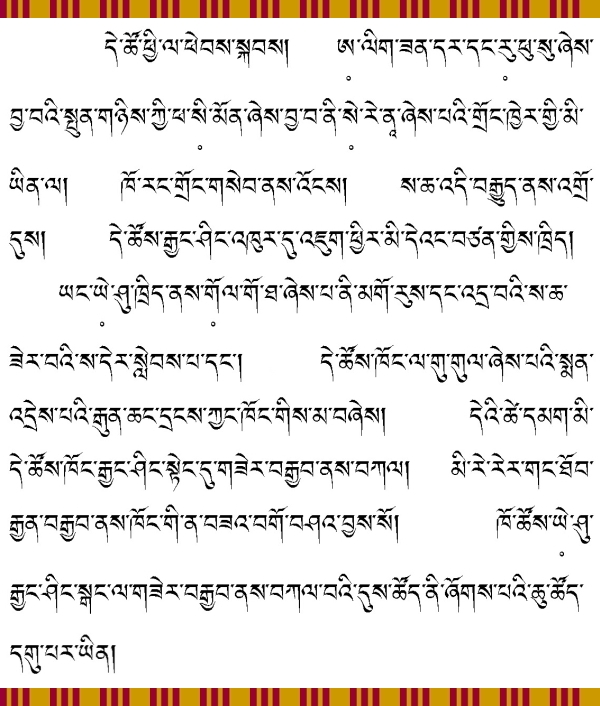
Tibetan Script Gospel Meditation – Mark 12:35-37

Mark 12.35-37 w B

And as Jesus taught in the temple, he said, “How can the scribes say that the Christ is the son of David? David himself, in the Holy Spirit, declared,

       ‘The Lord said to my Lord, Sit at my right hand, until I put your enemies under your feet.’

“David himself calls him Lord. So how is he his son?” And the great throng heard him gladly.

Yeshu now builds firmly on the teaching of the geshes (dge-bshes), and shows that Mashiga must not only be a human descendant of King David; he is also more than just human. He is both God and man.

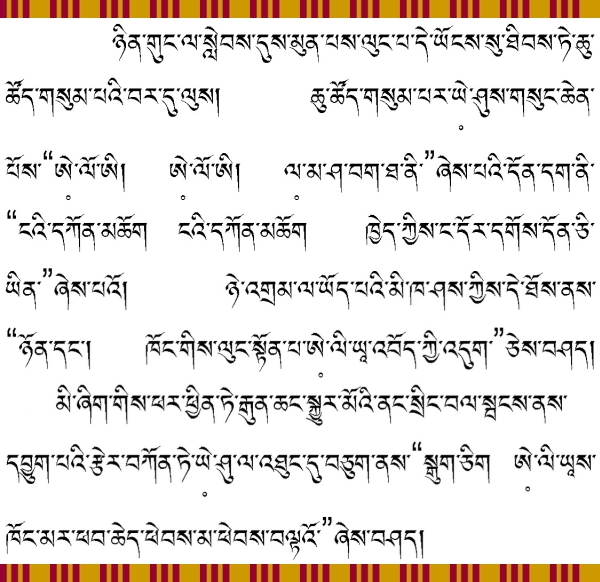
Tibetan Script Gospel Meditation – Mark 12:28-34

Mark 12.28-34 w B

And one of the scribes came up and heard them disputing with one another, and seeing that he answered them well, asked him, “Which commandment is the most important of all?”. Jesus answered, “The most important is, ‘Hear, O Israel: The Lord our God, the Lord is one. And you shall love the Lord your God with all your heart and with all your soul and with all your mind and with all your strength.’ The second is this: ‘You shall love your neighbour as yourself.’ There is no other commandment greater than these.”  And the scribe said to him, “You are right, Teacher. You have truly said that he is one, and there is no other besides him. And to love him with all the heart and with all the understanding and with all the strength, and to love one’s neighbour as oneself, is much more than all burnt offerings and sacrifices.” And when Jesus saw that he answered wisely, he said to him, “You are not far from the kingdom of God.” And after that no one dared to ask him any more questions.

At last a scribe with no feeling of enmity towards Yeshu asks one of those questions that was much debated among the scribes. And this scribe finds himself in full agreement with Yeshu about the order of importance of the commandments (bka’-khrims).

It is with love that we should obey our compassionate God; and with love we should serve other men whom He also loves. The people around who were listening knew Yeshu was right and that there was no need to debate such things.