
The Acts of the Apostles – Acts 17:22-34 མཛད་པ། 17:22-34

(མཛད་པ། 17:22-34)

Acts 17.22 - 34 w B


So Paul, standing in the midst of the Areopagus, said: “Men of Athens, I perceive that in every way you are very religious. For as I passed along and observed the objects of your worship, I found also an altar with this inscription: ‘To the unknown god.’ What therefore you worship as unknown, this I proclaim to you. The God who made the world and everything in it, being Lord of heaven and earth, does not live in temples made by man, nor is he served by human hands, as though he needed anything, since he himself gives to all mankind life and breath and everything. And he made from one man every nation of mankind to live on all the face of the earth, having determined allotted periods and the boundaries of their dwelling place, that they should seek God, and perhaps feel their way toward him and find him. Yet he is actually not far from each one of us, for

“‘In him we live and move and have our being’; as even some of your own poets have said,

“‘For we are indeed his offspring.’

Being then God’s offspring, we ought not to think that the divine being is like gold or silver or stone, an image formed by the art and imagination of man. The times of ignorance God overlooked, but now he commands all people everywhere to repent, because he has fixed a day on which he will judge the world in righteousness by a man whom he has appointed; and of this he has given assurance to all by raising him from the dead.”

Now when they heard of the resurrection of the dead, some mocked. But others said, “We will hear you again about this.” So Paul went out from their midst. But some men joined him and believed, among whom also were Dionysius the Areopagite and a woman named Damaris and others with them. (Acts 17:22-34)


Although there were so many shrines and religious societies in Athens, there were also many people, as in Asia today, who did not in truth know what they should believe or which of those idol gods they should visit and worship.

Paul, given his opportunity to speak in the open air, declared boldly that there is indeed a knowable God, the One who created the world and all mankind. ‘He is not some carved and gilded man-made statue, but He is the one true and living father-like God, who deserves and justly demands man’s worship. So repent, and believe in the man chosen to judge us all on the Judgment Day; and who this man is we all may know because God raised him’, he said.

Among Paul’s educated hearers just a few were persuaded to believe.

The Acts of the Apostles – Acts 18:1-17 མཛད་པ། 18:1-17

(མཛད་པ། 18:1-17)

Acts 18.1-17 w B


After this Paul left Athens and went to Corinth. And he found a Jew named Aquila, a native of Pontus, recently come from Italy with his wife Priscilla, because Claudius had commanded all the Jews to leave Rome. And he went to see them, and because he was of the same trade he stayed with them and worked, for they were tentmakers by trade. And he reasoned in the synagogue every Sabbath, and tried to persuade Jews and Greeks.

When Silas and Timothy arrived from Macedonia, Paul was occupied with the word, testifying to the Jews that the Christ was Jesus. And when they opposed and reviled him, he shook out his garments and said to them, “Your blood be on your own heads! I am innocent. From now on I will go to the Gentiles.” And he left there and went to the house of a man named Titius Justus, a worshiper of God. His house was next door to the synagogue. Crispus, the ruler of the synagogue, believed in the Lord, together with his entire household. And many of the Corinthians hearing Paul believed and were baptized. And the Lord said to Paul one night in a vision, “Do not be afraid, but go on speaking and do not be silent, for I am with you, and no one will attack you to harm you, for I have many in this city who are my people.” And he stayed a year and six months, teaching the word of God among them.

But when Gallio was proconsul of Achaia, the Jews made a united attack on Paul and brought him before the tribunal, saying, “This man is persuading people to worship God contrary to the law.” But when Paul was about to open his mouth, Gallio said to the Jews, “If it were a matter of wrongdoing or vicious crime, O Jews, I would have reason to accept your complaint. But since it is a matter of questions about words and names and your own law, see to it yourselves. I refuse to be a judge of these things.” And he drove them from the tribunal. And they all seized Sosthenes, the ruler of the synagogue, and beat him in front of the tribunal. But Gallio paid no attention to any of this. (Acts 18:1-17)


Paul left Athens, capital of modern Greece, for Corinth, the Roman capital of Achaia which was their name for Greece (See map in the post of February 16, 2017). The city of Corinth had been given by them a degree of autonomy.

He lived with Christian Jews, Aquila and Priscilla, and earned his keep by helping them in their business. That was until Silas and Timothy came, bringing perhaps financial gifts for his upkeep from the new Macedonian churches such as the one at Philippi.

The reaction of the Jews to Paul’s preaching of Jesus was insulting, with the exception of the important ruler Crispus; after this many others too believed.

Then, when hostile Jews joined together in a big attack on him, the Roman governor refused to exercise any judgment over purely Jewish matters. Jesus protected Paul as he had promised.

paul-2nd-journey-120-800px

The Acts of the Apostles – Acts 18:18-23 མཛད་པ། 18:18-23

(མཛད་པ། 18:18-23)

Acts 18.18-23 w B


After this, Paul stayed many days longer and then took leave of the brothers and set sail for Syria, and with him Priscilla and Aquila. At Cenchreae he had cut his hair, for he was under a vow. And they came to Ephesus, and he left them there, but he himself went into the synagogue and reasoned with the Jews. When they asked him to stay for a longer period, he declined. But on taking leave of them he said, “I will return to you if God wills,” and he set sail from Ephesus.

When he had landed at Caesarea, he went up and greeted the church, and then went down to Antioch. After spending some time there, he departed and went from one place to the next through the region of Galatia and Phrygia, strengthening all the disciples. (Acts 18:18-23)


Having performed a vow, perhaps of thanks to God, Paul went back by stages to his home church at Antioch in Syria. The first stage by sea took him to Ephesus, the main city of the province of Asia.

Because of his plan Paul did not accept the Ephesian Jews’ invitation, but he left Aquila and Priscilla with them. He did return. (Read future posts about this)

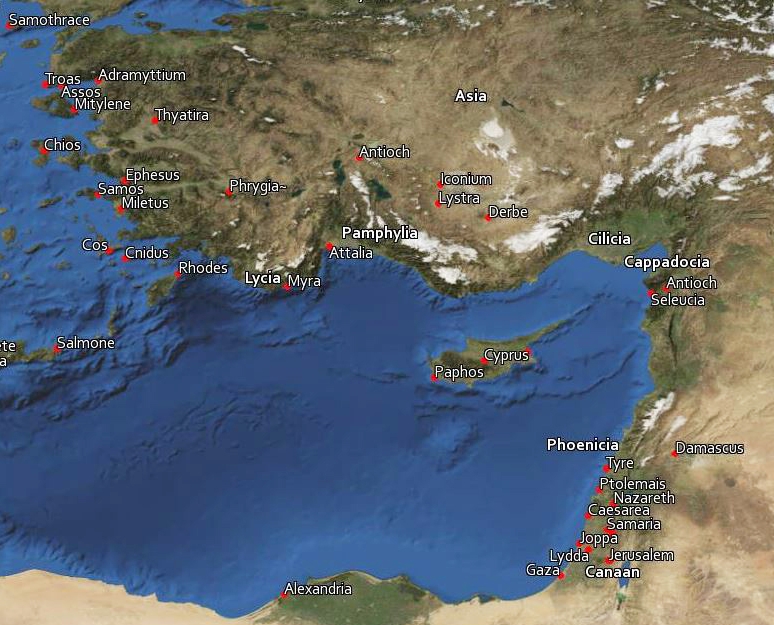
After visiting the church in Jerusalem and reporting back in Antioch Paul’s second journey was now finished. Later he set off again on his third missionary journey by first of all revisiting the young churches in Galatia such as those at Iconium and Lystra. (See map)

Paul 3rd Journey - 121 - 800px